
Showing posts with label Amit Trivedi. Show all posts
Showing posts with label Amit Trivedi. Show all posts
Saturday, February 25, 2017


Saturday, January 14, 2017
14th January 2007 - a decade back ...
It was exactly 10 years ago on 14th January 2007 that an article I had written appeared in main stream media for the first time. The financial daily was Business Standard and the article was entitled "Simple Things About Compound Interest". I thought of writing this article when I saw how some companies using misleading communication regarding interest rates offered on fixed deposits or on return on investment. Interestingly, after this article appeared in Business Standard, one such advertisement was removed by the advertiser from the billboards across Mumbai.
A decade later, the article is still relevant.
 In these 10 years, 351 articles have appeared in various publications with the mainstream media taking the lion's share of 233 articles (roughly 2/3rd of the total published articles).
Thank you everyone - the publications, the editors, the editorial and support staff, the readers, the patrons, and friends & family. your support was phenomenal. Thank you God for giving me this opportunity.
Wish you all a very happy Makar Sankranti, happy Bihu, happy Pongal, happy Baisakhi, happy Uttarayan.
A decade later, the article is still relevant.

Thank you everyone - the publications, the editors, the editorial and support staff, the readers, the patrons, and friends & family. your support was phenomenal. Thank you God for giving me this opportunity.
Wish you all a very happy Makar Sankranti, happy Bihu, happy Pongal, happy Baisakhi, happy Uttarayan.
Friday, January 13, 2017

Thursday, December 29, 2016
What happens if I forget to pay my SIP installments?
| "What happens if I forget to pay my SIP installments? Will I be fined?" Click on this link to read the answer. ________________________________________________________________________________________ The English translation is as under:
“Is there any penalty, if I skip an installment or two of my SIP?”
“What is the minimum period for which I must continue my SIP? What
if I don’t? Will my money be confiscated?”
These are some of the questions that I regularly face during my
interactions with investors, especially in large investor meetings. I tried to
understand why these questions keep coming. I think the primary reason is that
SIPs in mutual funds are being compared with other forms of regular savings,
e.g. recurring deposits, insurance premia, PPF contributions. Even EMIs on
loans have various conditions regarding regularity and term.
SIP in a mutual fund scheme, on the other hand is just a convenience
and not a compulsion. At best, it can be termed as a commitment to yourselves.
To that extent, one may start an SIP for 100 years and then discontinue the
same after a few months. While the future installments would not be deposited
in the SIP account, all the previous installments would continue as investments
in the same mutual fund account.
We have discussed in the past about various benefits of SIP. Let us
highlight some of the operational aspects of the same to clarify and answer the
questions raised in the beginning. SIP offers some great operational
conveniences to channel your regular savings into investments of your choice.
The investments can be made in equity funds, balanced funds, debt funds, liquid
funds, international fund or even gold funds – you can choose the option.
You are required to give post-dated cheques or a standing
instruction to your bank through NACH mandate registration. The period can be
chosen based on your cash flow – if you are 55 years and wish to invest for the
next 5 years till your retirement, start an SIP for 5 years. If you are 27
years old and do an SIP for purchasing a house when you turn 33, start an SIP
for 6 years. If you are 31 year old with a 1-year-old daughter, you may start a
16-year SIP to fund her college education.
If you want to increase the amount of SIP, there are few fund houses
that offer you to mention this right at the beginning – you may increase your
monthly investment amount every year by a certain amount. If such option is not
available with the fund house you have chosen, you may always start another SIP
– either in the same scheme or any other scheme. If you wish to change the
scheme, you may discontinue your SIP in the present scheme and start in another
one. All these flexibilities make it convenient for an investor.
Now let us come to the commitment part. What if your cheque bounces?
Not to worry. Most fund houses do not charge any penalty for that. However, in
majority of the cases, if three of your cheques bounce or a certain number of
(three, in many cases) consecutive debits are rejected by your bank (for
whatever reasons), the fund house may consider it as you are not interested in
continuing the SIP and hence stop depositing your cheques or cancel the debit
(NACH) mandate to debit money from your bank account. In case such a thing
happened by mistake, you may always restart an SIP – either in the same account
or in another. There is no revival charge.
At the same time, let us understand the penalty aspect of any
commitment. If you enter into an agreement, and want to terminate the same
before the due date, there could be penalty payable to the other party, as per
the terms of the agreement. As we have already mentioned, an SIP is your
commitment only to yourself and nobody else. This means, if there is any
penalty levied – who would pay and who would get it? The penalty is levied by
your present self and paid by your future self. In other terms, while your
present self may indulge into some spending, the future self is deprived off
wealth and hence purchasing power. This affects the lifestyle of your future
self. Be aware of this penalty. Understand the implication of this. Plan your
SIP keeping in mind your present requirements as well as your future
requirements. Strike a proper balance so that you enjoy life in the present as
well as in the future.
So, please go ahead. Plan an SIP for your future needs, as permitted
by your cash flow.
- Amit Trivedi
|
Thursday, December 22, 2016
When bond fund SIP beats equity fund SIP ...
When bond fund SIP beats equity fund SIP…
Investors must understand why such a situation exists and the lessons it leaves for the investors.
Read more at: http://www.moneycontrol.com/news/mf-experts/when-bond-fund-sip-beats-equity-fund-sip%E2%80%A6_8151621.html?utm_source=ref_article
When bond fund SIP beats equity fund SIP: Investors must understand why such a situation exists and the lessons it leaves for the investors.Read more at: http://www.moneycontrol.com/news/mf-experts/when-bond-fund-sip-beats-equity-fund-sip%E2%80%A6_8151621.html?utm_source=ref_article
Investors must understand why such a situation exists and the lessons it leaves for the investors
Read more at: http://www.moneycontrol.com/news/mf-experts/when-bond-fund-sip-beats-equity-fund-sip%E2%80%A6_8151621.html?utm_source=ref_article
Read more at: http://www.moneycontrol.com/news/mf-experts/when-bond-fund-sip-beats-equity-fund-sip%E2%80%A6_8151621.html?utm_source=ref_article
When bond fund SIP beats equity fund SIP…
Monday, December 5, 2016
What you need to invst in equity markets - well, apart from money, time and knowledge ...
Below is the link to one of my old articles - published in Mumbai Samachar
http://www.bombaysamachar.com/frmStoryShow.aspx?sNo=29199
The English translation is as under:
Amit has authored a book "Riding The Roller Coaster - Lessons from financial market cycles we repeatedly forget. The book is available in two languages - English and Gujarati.
http://www.bombaysamachar.com/frmStoryShow.aspx?sNo=29199
The English translation is as under:
Mental fitness
Last week when
the Sensex made a two-year low, I received a sarcastic SMS from a friend: “New
SEBI rule from today: If you want to trade in stock markets or the derivatives
markets, additional documents must be submitted along with your PAN card and
KYC documents. These new documents include cardiograph, your blood pressure
readings and fitness certificate from a doctor.”
This conveys the
amount of stress that the stock market movements can cause to common men. Money has a profound impact on our mental
state.
I have always
wondered: I thought we invest our money to get peace of mind, but one has seen
many losing the peace of mind after investing. In fact, there have been cases
of suicide linked to losses incurred in the stock and derivatives markets. This
is very disturbing. Why should someone get into something that leads to such a
tragic end?
Does it mean
stock markets are bad? No, not really. It is like railway tracks. There have
been many cases of people losing lives while crossing railway tracks instead of
using the foot over bridge. Does it mean railway tracks are bad?
In majority of
such cases, the mechanism – be it stock markets or railway tracks – are made
for certain purpose. If one misuses the system, one should be ready to pay for
the consequences.
The other day,
one gentleman was talking to his friends about the stock markets and compared
the stock market with a casino. Very often, such phrases are used only because
there are some misunderstandings prevailing about the stock markets.
So let us
understand what exactly is the function of the stock market. As the name
suggests, it is a marketplace where buyers and sellers meet and exchange their
stocks or money. The stock market’s function is to provide a platform where
such transactions happen smoothly and very efficiently, at the same time
keeping the transaction costs as low as possible. Once such a platform is
available, the stock market is neutral. It does not know or care how one uses
this facility. It is available for the transactions.
Whether someone
buys it cheap or costly; whether someone sells it cheap or costly – the market
is neutral. It does not care at what price the transaction happens since it
allows each individual to take a decision to buy or sell at the prevailing price.
The transaction price is arrived at jointly by all the participants and is a
function of the demand-supply situation. The market does not determine the
transaction price.
The demand-supply
situation is a function of the information processed by the various buyers and
sellers. This is where the responsibility of proper assessment of information
lies with the person who transacts.
The stock market
provides a platform for the transaction and ensures that the cost of
transaction remains low.
One would be
better off treating the market only as a market – a place for carrying out the
transactions. Why one is selling or buying depends on an individual’s view on
the particular security.
We come back to
the initial paragraphs. If we understand the function of the market, it means
that the responsibility of the decision and its consequences lies only with us.
Taking these decisions requires mental toughness since at any time, there will
be people who have different views – some optimistic and some pessimistic. The
success in investing comes when one can take decisions with a calm state of
mind. To get a better perspective, please read the story of “Mr. Market” from
the book “Intelligent Investor” by Benjamin Graham.
Hence, I would
make a simple change in the SMS we spoke about in the first paragraph: One does
not need a cardiograph or blood pressure report; one needs a mental fitness
certificate. One needs to develop better abilities to take proper decisions to
succeed in the world of investing.
Happy investing!
Amit Trivedi
The author runs Karmayog
Knowledge Academy. The views expressed are his personal views. He can be
reached at amit@karmayog-knowledge.com.
Amit has authored a book "Riding The Roller Coaster - Lessons from financial market cycles we repeatedly forget. The book is available in two languages - English and Gujarati.
Monday, November 7, 2016
Transcript of today's chat on www.moneycontrol.com
Click on the link below to read the transcript of chat on www.moneycontrol.com today:
Equity investments simplified
Equity investments simplified
How active is your equity fund?
How active is your equity fund, really? Is there a difference between an active fund and a passive fund? Are all actively managed funds really very actively managed? How do you know?
Click here to read further.
Click here to read further.
Saturday, November 5, 2016
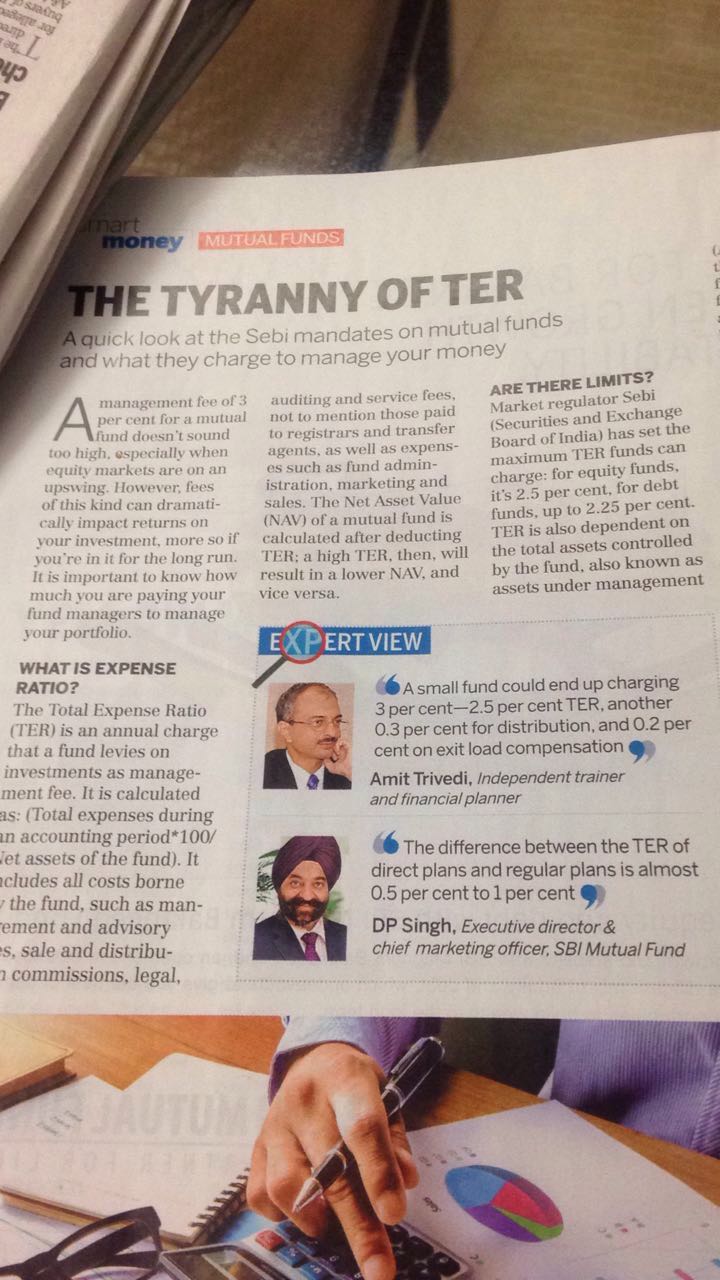
Quoted in India Today
In a story related to the TER on mutual funds, my quote was taken by India Today.
Here is the photo of the relevant page

Here is the photo of the relevant page
Thursday, November 3, 2016
Get answers to your questions on mutual funds
Do you have questions regarding mutual funds? Get answers during the live chat on www.moneycontrol.com on 7th November, 2016 at 4:00 PM to 4:30 PM
Tuesday, October 25, 2016
Build wealth through mutual funds - chat transcript
Transcript of my chat today on www.moneycontrol.com
http://www.moneycontrol.com/news/mgmtinterviews/chats/detail_new.php?chatid=24&source=mym
http://www.moneycontrol.com/news/mgmtinterviews/chats/detail_new.php?chatid=24&source=mym
Master Your Money - live chat
I will be answering questions on live chat on www.moneycontrol.com in the Master Your Money segment today between 3:00 to 3:30 PM
Monday, October 24, 2016
A good investment option amidst volatility
We looked at various asset allocation schemes last time. This time, we will discuss a variation of these schemes - dynamic asset allocation schemes.
Click on the link here to read further.
____________________________________________________________________________________
The English translation is as under:
Click on the link here to read further.
____________________________________________________________________________________
The English translation is as under:
Last time, we covered asset allocation funds. This time we will look
at a variant of the same, known as “dynamic asset allocation” funds. While we
discussed about investing in multiple asset categories, the focus of the
discussion was about maintaining certain proportion in each of the two or three
asset categories.
However, periodically, when one asset category becomes costly, does
it make sense to reduce the allocation? Similarly, should one increase the
allocation in the asset that has become cheaper? There is a school of thought
that suggests, “Yes, we should”.
Mutual fund companies have come up with schemes that work on such
principles. These schemes invest in more than one asset categories – in most
cases these invest in two assets. Most such schemes allocate money between
equity and debt.
The allocation between equity and debt is altered periodically. In
order to determine the allocation to the two asset categories, there are two
approaches:
1.
The fund manager alters the
allocation based on his/her views on the two asset categories.
2.
The allocation would change on
the basis of some pre-decided formula.
In the first case, when the fund manager is bearish on equity
market, the scheme would reduce equity exposure. However, when one is bullish
about equity, the allocation would go up.
In the latter, most often, valuation determines how much should be
allocated where. The allocation would be reduced from (or increased in) the
asset that has become costly (cheaper) as indicated by certain valuation
parameters. However, some of the schemes only look at valuation of equity.
There is at least one scheme that compares the valuation of equity and debt and
changes the allocation accordingly.
The valuation parameters:
For the purpose of evaluating equity valuation, most consider the
P/E ratio or the P/BV ratio. Both these ratios are popular indicators of
valuation. As a thumb rule, it is believed that higher the number, costlier the
market (or a sector or a stock). Fund schemes follow a certain pre-defined
pattern through which the allocation in equity is reduced step-by-step when the
valuation goes up and increased when the valuation goes down.
In one case, the scheme’s allocation is altered based on the gap
between the yield on Government Security with 10-year maturity and the
“earnings yield” for equity. The earnings yield is the inverse of P/E ratio.
These are schemes designed to reduce short-term fluctuations in the
scheme’s NAV. At the same time, such schemes are expected to deliver at least
as much as a fund that evenly allocated money between equity and debt.
Very often, investors have compared such schemes to pure equity
funds. That is a mistake. Given that these schemes invest at least some
proportion and often a large chunk in debt securities, it would be improper to
compare these with pure equity funds.
Should an investor consider investing in such schemes? Well, that
entirely depends on whether the investor needs such a scheme in the first
place. Having said that, one may consider such a scheme with an expectation of
reduced price fluctuations compared to a hybrid scheme that does not change the
allocation.
It’s a good category to explore for investors. However, a deeper
analysis is warranted since the alternatives can have significant differences
among them.
-
Amit Trivedi
The
author runs Karmayog Knowledge Academy. Recently, Amit has authored a book
titled “Riding the Roller Coaster –
Lessons from Financial Market Cycles We Repeatedly Forget”. The views
expressed are his personal opinions.
Monday, October 17, 2016
Another high on the roller coaster ride
Gujarati edition of my book "Riding The Roller Coaster - Lessons from financial market cycles we repeatedly forget" is available for pre-order now on www.amazon.in
See the details below:
Monday, October 10, 2016
Monday, October 3, 2016
Asset Allocation schemes - managed risk, enhanced returns
Some mutual fund houses have launched schemes known as the “asset
allocation schemes”. What are these schemes? How do they operate? Should one
consider investing in such schemes?
Read my article in Mid-day Gujarati edition today on the subject of asset allocation ..._________________________________________________________________________________
The English translation of the same is as under:
Some mutual fund houses have launched schemes known as the “asset
allocation schemes”. What are these schemes? How do they operate? Should one
consider investing in such schemes?
Before answering the above questions, it is important to understand
what asset allocation means. It is a process to allocate one’s investments
across various asset categories. The reasons behind asset allocation, the
reasons why and how much money is allocated to different asset categories could
be either unique to the investor or sometimes based on the fund manager’s view
on the opportunities in different asset categories.
Since mutual fund companies cannot customize the schemes for
individual investors, the logic of investing the fund’s investments across
asset categories cannot be done in line with the investors’ needs. Hence, the
objective of the asset allocation schemes launched by mutual fund companies
would be to generate better risk-adjusted returns. Some people call these
schemes offer peace of mind to investors, as the returns are decent, but the
price fluctuations are moderate.
For this purpose, money in the scheme is invested across more than
one asset classes. Since the market prices of different assets move
differently, the scheme’s NAV exhibits moderate movement only.
Let us assume that a scheme has invested in both equity and debt. As
we all understand, market prices of equity and debt do not move together. At
some time, when the equity prices could be down, debt might have gone up. This
is when the down movement of equity would be compensated partly by the up
movement of debt prices.
The reverse may also happen when the debt prices do not move much or
move in negative direction, equity might be up.
Thus, the opposite movements tend to cancel each other out partly, which
lowers the fluctuation in the NAV of the scheme.
The asset allocation schemes may allocate money across more asset
categories. in the Indian mutual fund industry, we have schemes that invest in
various combinations of equity, debt and gold.
In certain cases, the schemes define the allocation across the asset
categories and keep the same fixed. So, a scheme may invest 60% in equity and
40% in debt. At a pre-defined frequency the allocation would be checked and if
required, would be restored to the 60-40 ratio.
Some schemes may give some flexibility to the fund manager to alter
the allocation marginally, based on his or her market view. Such schemes depend
on the portfolio manager’s abilities to improve the scheme’s performance.
There are some schemes that allow changes to the set percentage
allocation based on certain valuation parameters. We will talk about such
schemes in our next article.
Till then, keep an eye on the asset allocation schemes. In fact, two
categories of funds that we have already covered earlier are Balanced Funds and
MIP (or Monthly Income Plans). These are also known as hybrid schemes.
One must be careful to check whether the allocation between equity
and debt is fixed at a certain ratio or the fund manager has a leeway to change
it as per the outlook. For this purpose, one needs to check the following:
1.
The Scheme Information Document
(popularly known as the SID) contains the details of asset allocation allowed.
Read the table as well as the text below it., and
2.
The fact sheet contains the
details of actual investments made by the scheme. Even when the fund manager
has the flexibility to change the asset allocation, more often, the same is not
used and the allocation is kept fixed.
If the allocation is kept at a near-constant ratio, one is not so
much dependent on the fund manager’s outlook on the different asset categories.
However, when the fund manager keeps changing the allocation between equity and
debt, it requires skills. These skills can add to the returns, but at the same
time are subject to the risk of the fund manager’s judgment being wrong.
Happy investing to you all.
-
Amit Trivedi
The
author runs Karmayog Knowledge Academy. Recently, Amit has authored a book
titled “Riding the Roller Coaster –
Lessons from Financial Market Cycles We Repeatedly Forget”. The views
expressed are his personal opinions.
Wednesday, September 21, 2016
Why mutual funds do not guarantee returns? And why is it good?
Though guarantee is a sought after factor for many investors, it still makes sense not to go for it.
Read more at: http://www.moneycontrol.com/news/mf-experts/why-mutual-funds-do-not-guarantee-returns-andis-it-good_7493481.html?utm_source=ref_article
Read more at: http://www.moneycontrol.com/news/mf-experts/why-mutual-funds-do-not-guarantee-returns-andis-it-good_7493481.html?utm_source=ref_article
Monday, September 19, 2016
Transcript of today's chat on www.moneycontrol.com
Click on the link below to read through the transcript of today's chat on www.moneycontrol.com
Equity investments simplified
Equity investments simplified
How is the NAV of a mutual fund scheme calculated? Do the inflows and outflows in the scheme impact the NAV?
The other day, in an investment seminar someone asked a question: “How is the NAV calculated?” He also wanted to know if the daily inflows and outflows in the fund by investors impact the NAV calculations apart from the movement in the prices of securities held by the fund.
Read my article in Mid-day Gujarati edition today to understand the NAV calculation:
Mutual Fund NAV calculation
Read my article in Mid-day Gujarati edition today to understand the NAV calculation:
Mutual Fund NAV calculation
The other day, in an investment seminar someone asked a question:
“How is the NAV calculated?” He also wanted to know if the daily inflows and
outflows in the fund by investors impact the NAV calculations apart from the
movement in the prices of securities held by the fund.
Let us look at both parts of the question and answer each. First of
all, what exactly is NAV in the context of a mutual fund?
NAV is the Net Asset Value of the fund – popularly mentioned as NAV
per unit. In the accounting parlance, NAV is the other name for book value. This
is the value of the scheme’s total assets less the liabilities. If you simply
add up all the assets and deduct all the liabilities of the fund, you get the
value of the net assets. Divide this by the number of outstanding units and you
get the NAV per unit.
NAV per unit = (total assets of the scheme – total liabilities of
the scheme)
---------------------------------------------------------------------------
Number
of outstanding units
This looks simple. Having reached till here, we need to understand
what the fund’s assets and liabilities are.
A mutual fund scheme invests in many securities as per the
investment objective. We have discussed this earlier. The market value of these
securities (or investments) forms the major part of the fund’s assets. Apart
from that there are some minor contributors, e.g. interest accrued but not
received, dividend declared but not received yet, proceeds receivable on sale
of investments, money parked in money market instruments and bank balance. All
these are examples of the fund’s assets. The value of investments has to be
taken as the current market price, which is an indicator of the realizable
value of the scheme’s assets.
Now come the liabilities. We saw earlier that a mutual fund cannot
borrow money for the purpose of investing. The only exception allowed is when
the fund has to meet redemptions or dividend payouts and is unable to liquidate
the investments due to some critical factors like a market meltdown or illiquidity
in the system. Such a liability, if exists, should be added to the fund’s total
liabilities. At the same time, there are some liabilities that exist on a
regular basis. These are fees payable to various constituents like the asset
management company, the custodian, bankers, R & T agent, directors,
auditors, distributors, etc. there could also be liability on account of
payment to be made for securities purchased. All the liabilities get added up
and these have to be deducted from the fund’s assets.
As mentioned earlier, this would give the net assets of the fund.
Dividing this by the number of outstanding units would give the NAV
per unit. This NAV has to be calculated on a daily basis. The accounts students
among the readers can easily make out that in order to arrive at the fund’s net
assets, the scheme’s balance sheet must be prepared. Since the NAV is
calculated on a daily basis, the balance sheet is also prepared daily. Which
business would be preparing final balance sheet daily? This is another example
of the transparency of a mutual fund.
This answers the first part of the question – regarding the
calculation of NAV.
Now let us consider the second part of the question. “Do the daily
inflows and outflows impact the NAV of a scheme?” as you can see in the answer
to the first question; the inflows and outflows into or out of the scheme do
not feature in the NAV calculation. However, many keep asking if these inflows
and outflows have any impact on the scheme’s NAV.
Well, the short answer is “no, they do not impact the NAV on a daily
basis.” However, this is a simplistic answer and only looks at the theory. It
is also important to check whether these have any impact on the NAV, at all.
When an investor purchases the units of the scheme, there is an
inflow of money in the scheme. The scheme allots units at the prevailing NAV.
This is the NAV that has been calculated as discussed earlier. The investor,
who submits the purchase application before the cut-off time, gets units at the
NAV calculated based on the closing prices for the day. Exactly same process is
followed when an investor takes money out of a scheme.
As can be seen, the inflows and outflows do not impact the NAV.
However, when a scheme receives huge inflows in relation to its
corpus, the fund manager may not be able to invest all the money immediately.
This means, cash would be held in the portfolio for a considerable amount of
time. This impacts the future NAV changes since cash and securities may not
move together.
This is a small point that must be kept in mind. At the same time,
since short term price movement is unpredictable and there is an (almost) equal
probability that the prices may move up or down in the short run, this impact
may get cancelled out over the years.
-
Amit Trivedi
The author runs Karmayog Knowledge Academy.
Recently, Amit has authored a book titled “Riding
the Roller Coaster – Lessons from Financial Market Cycles We Repeatedly Forget”.
The views expressed are his personal opinions.
Subscribe to:
Posts (Atom)

 Posts
Posts

